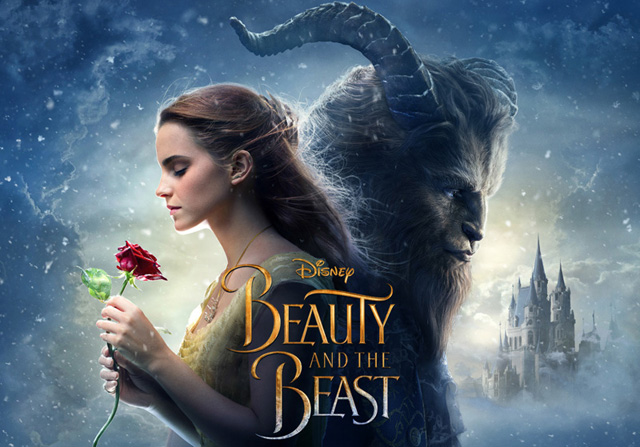
A couple weekends ago the hubby and I went to see Beauty and the Beast. WOW, people. WOW. I don’t know if it’s just been a long time since I’ve seen the original, but I was blown away by the acting and magic that is Disney, as well as the plot and the themes found in the movie. I’m ever the Seminary nerd, so I cannot help but look for the theological and societal implications of a movie, which for me come through mostly in Belle’s character. While I found some things problematic (and I wouldn’t be a good Seminarian if I didn’t address those issues), I thought the movie was surprisingly profound.
Let’s talk about Belle because she is the real hero of the story. Even though Beast saves her from the wolves, it is Belle who then takes him back to the castle and nurses him to health. It is Belle who saves his cold and hardened heart. It is Belle’s love that saves him and his staff from the curse the Enchantress put upon them all. Belle is the one who goes after her father when the townspeople want to throw him in an asylum. It is Belle who stands up to Gaston, to Beast, and to the townspeople throughout the whole movie.
Belle is a hero through and through. She is not just any hero either. More specifically, Belle is an intelligent, compassionate, and brave hero. And of all the many different qualities heroes are made of, Belle’s are some of the best (or maybe just some of my favorite). More traditionally Belle is known as a Disney princess, but the remake has helped me realize that she is both a Disney princess and a Disney hero. Thank God she is both.
Throughout the movie we see her reading constantly and she falls in love with Beast’s library the moment she sees it. She wants to read as much as she can and know more of the world than her small-minded village could ever give her. She helps her father with mechanical repairs, as well as inventing her own way of doing everyday tasks. At one point, she invents a new way of doing laundry that allows a donkey to do her laundry instead of needing to attend it. She takes her extra free time and begins to teach another girl to read. Naturally, she is chastised for this.
Intelligence is not the only factor in making a good hero, but combine it with compassion and bravery and it makes a hero unstoppable. Belle’s compassion is witnessed in her worry and care over her father. She goes after him not just once, but twice, and each time it is into a dangerous situation. She willingly volunteers herself for Beast’s imprisonment to allow her father to go free. She takes his place. Then she goes after him to save him a second time, this time from the villagers. My favorite moment from the whole movie is in this particular scene. She’s been locked in a carriage with her father while Gaston and the townspeople leave to kill Beast. She looks at her father and tells him that she must help. She must go back to Beast and help him. Her father looks at her and says, “It will be dangerous.” Emma Watson wins my heart and Belle solidifies her place as one of Disney’s greatest heroes in this moment. She looks at her Papa and says, “Yes. Yes. It will be dangerous. It will be very dangerous.”
Wow.
Wow.
Did you hear it?
Did you get goosebumps too?
Because I almost burst into tears in the theatre when she said that. Her acknowledgment of the danger is profound. And yet she is willing to ride into the face of grave danger for the sake of compassion. Bravery is not ignorance. It isn’t the man who muscles his way through danger because he thinks he can beat the situation with strength. It isn’t the man who doesn’t stop to think about the situation into which he’s entering. No, bravery is not that. Bravery is knowing the danger and choosing to enter into it for the sake of something greater, something that will change a life. Bravery comes to us in the form of a woman hearing her father’s statement and saying, “Yes, I know. I know how dangerous it is. I know that it’s not just dangerous, but that it’s very dangerous.” And yet, she is going head straight into that danger, without her father at her side, because not only does she love Beast, but she has compassion for him. She sees people in need and she helps them.
Some might argue here that she is forced into the role of caretaker because she’s a woman in her society and that’s the role in which they’ve been placed. While I would normally agree, I’m not convinced that’s all this is. Belle, in so many ways, does not conform to the women in her village, and she exercises choice in caring for Beast and her father. She makes a choice to save Beast, not once, but twice. Her compassion comes from her ability to see past the small-mindedness of her village and she chooses to exercise that compassion. Her bravery combined with her compassion and intelligence make for the best kind of hero.
Not only have I been taken with Belle, but I love the way Emma Watson portrays Belle. She doesn’t portray her as a weak, frail individual. Even in her slender frame, Watson portrays Belle with strength. There’s a toughness about Belle that comes from within. She has a natural determination to win out. I adore this about her. I’m also grateful that she doesn’t ‘fall in love’ in a doe-eyed sort of way. She falls in love because they talk and spend time together. They bond over books and exploring the world. Belle falls for Beast because they become friends first. And Beast falls in love with Belle because he’s able to bring his walls down and let in someone else. He’s also finally able to look past his classism that he harbors the whole movie to see that Belle is actually a person of value.
While I was enamored with the character of Belle, the character who stood out as most problematic for me was LeFou. He is humorous and seems to have a change of heart at the end about helping Gaston, with whom he is clearly smitten. His character, however, is fairly one dimensional. This ‘gay’ character shows us little depth. People were outraged that Disney would write a gay character into the script. LeFou might be gay, but he is barely out of the closet, if he can even admit that he is in the closet. I’m tired of the troupe: the GBF (gay best friend) who provides the laughs and really doesn’t have much character depth. I’m tired of people being outraged over the seemingly gay character who is only a minor character written for comedic relief. Get a grip, people. I’m sure that what I’m really waiting for will certainly make people mad: a gay Disney princess. I’m ready for the main character to be a princess who falls in love with another woman, maybe a princess or maybe just a commoner. I’m ready for Disney to tell the tale of LGBTQ people outright, and not in the overarching metaphor of Frozen. And if we cannot aspire to include queer people in the main characters, at least give us some depth and don’t create us just for your entertainment.
Despite my frustration with the ‘gay’ character of LeFou, I still loved Beauty and the Beast. If you haven’t seen it, I urge you to do so. Disney teaches through this movie that love doesn’t come from seeing a pretty face, but rather from the hard work of overcoming our own biases, talking with each other, sharing our interests over long walks and dinner, and seeing each other for who we really are. Beauty and the Beast also gives us a hero to help our children learn from, to model their own lives after. I refrained from saying that it helps our daughters learn how to be a hero. Because let’s face it, young children of all genders need a hero like Belle. All children need to learn that intelligence and compassion and bravery are all admirable qualities. All children need to learn that our heroes come to us in all shapes and sizes and genders. Our boys don’t just learn from men and girls don’t just learn from women. Our children who aren’t defined by binary gender need heroes too. And Belle is a hero worthy of our admiration. She is the hero I’ve always yearned for, intelligent and compassionate and brave beyond measure.

 Timothy Burge-Lape