Death on a Friday

Today is known by most Christians as Good Friday. I’m still not sure what’s so good about it. We commemorate Jesus’ death on this day. At this point, we’ve spent the last forty days journeying to the cross. This is the moment towards which we’ve been walking. All this talk about suffering and pain and death leads to this one moment: the death of our God. It seems like the culmination of the last forty days ends in this. It ends with the death of all the Good things we thought were going to come our way. It ends with the death of the One who can bring all Good things into existence, breathe them in our direction, grow new things in the universe. God dying is the most infinite form of death I can imagine. And the most terrifying.

I have put my trust into a God that can be killed by human hands. This God can be tortured and humiliated by people just like me. The love and persistence of a God who bears the symbol of a political death is the God I have chosen to follow. This can seem like a mistake at times, like I have made a mistake by following One so foolish. And yet it will seem foolish in two more days when we celebrate a God who rises from the dead. And we celebrate this on April Fool’s this year. I can think of no better way than to experience my faith. Lead me into the time of Lent with Valentine’s day. How romantic. How dreadfully poetic. And then lead me out of Lent and death with a fool’s day. This might be the best church calendar year ever.

Since today is Good Friday (or rather Bad Friday or Sad Friday), I’ve been thinking about death this week. It’s been particularly easy with all the rain and cloudy days we’ve been having. Go figure that the sun is out today. The weather is not making it easy to participate in the somber nature of today. I’m holding death and life in tension today, trying to make sense of both of them, how they fit together, side by side. But I’m also thinking specifically of death. I’m thinking about Trayvon Martin today. I’m thinking about Sandra Bland. I’m thinking about the seven transgender people killed this year already, about Syrian orphans being denied refugee status, about the death and injustice in the world. And this is where God stands next to us shouting “How long? How long will injustice prevail? How long before we stop killing black and brown bodies? How long will queer people still be rejected and trampled upon? When will refugees be welcomed with open arms? When will the violence and hatred end? When will we see the humanity in each and every individual?”

Today is the day that God says, “Me too.”

And that is something in which I can rest.

This is something I can trust.

This is a God I can follow.

A God who says, “Me too” is a God worth my time, worth my effort, worth my attention. This God is One whom I can wrestle with, stand side by side with, and raise my fist against injustice with.

And for this reason, I will mourn God’s death today. I will mourn it tomorrow. And I will sit in the death and sorrow of these two days, waiting for Easter to come. I will wait for God to wake from the grave and say, “Me too, honey. Me too.” And I will be relieved.
Learning Communal Lament

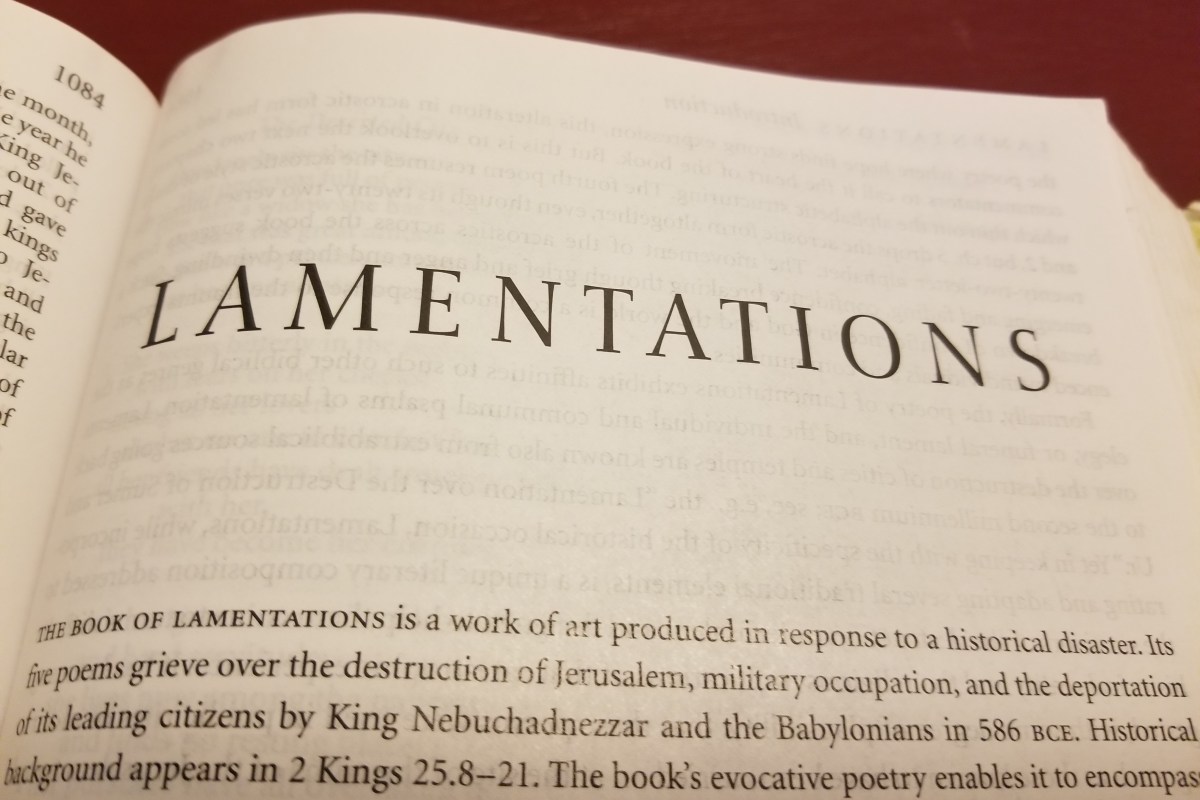
For Lent, our church is going through the book of Lamentations, which consists of five poems all centered around the occupation and exile of Judah by the Babylonians. The temple, which for the people of Judah, is where God resided was destroyed, leaving the people lamenting the destruction of the house of God. Where does God go when there is no home for God? Does God leave a people when there is no dwelling place? Did God leave them before and the Babylonians were their punishment? These are some questions with which Lamentations is beginning to grapple.

Lamentations is a book about grief. It’s a poetic representation of our communal grief. How do we grieve things together? It’s a book that allows us to be angry with God, to blame God, even if God is not at fault. There is room in our grief for anger. There is also room in our faith for this kind of grief and anger. The book is about a group of people who have been destroyed and occupied. It is a book about a group of survivors dealing with trauma.

Our pastor has been bringing out the individual nature of grief. What are we grieving this Lent? What do we need to do in order to properly grieve? This is important. It is important to learn how to grieve and to do it well. It is also important for us to learn how to handle other people grieving, how to give them space to be angry, to cry, to blame God, to question God, regardless of where blame ought to lie. These are all good things for us to learn.

My mind, however, immediately went to thoughts about communal grief, particularly as a white male. I am someone who benefits both from my whiteness and my maleness. How can I, as a white person, identify myself in the story of Lamentations? I do not grieve the destruction of white people. My white ancestors are the ones who destroyed entire nations of Native Americans and have occupied their lands for hundreds of years. My white ancestors are the ones who enslaved Africans and brought them to the Americas. I do not identify with those lamenting in this Scripture. I identify with the descendants of those who did the destroying, occupying, and enslaving.

Therefore, I am left wondering how to grieve the sins of those who came before me. How do I grieve white supremacy? How do I sit with the grief that I benefit in numerous ways because of my whiteness that black and brown skinned people do not? I’m left feeling angry at the injustice. I’m left feeling frustrated with my own complicity in the ransacking of the Temple, in the systematic oppression of black people in the U.S. In the past I have felt defensive and thought things such as: I didn’t enslave anyone. I didn’t kill anyone, incarcerate somebody, or enact racist laws. But, I must contend with the fact that I benefit from white people who did. I am in a place of privilege because white people before me did those things.

While I feel disconnected from white people as a racial identity, I must also acknowledge that I am intricately linked to all the white people who came before me. In lieu of the Old Testament, I must learn what it means to ask for communal forgiveness for what my white European ancestors did to Native Americans and African Americans. I must learn how to claim those as my people and to repent for their sins. I must learn that I don’t get to pick and choose the community I came from, that I don’t get to pretend their sins don’t benefit me now.

While Lamentations doesn’t feel like a book written for me to give lament to my own individual grief, it is a book that is giving me new eyes to see those who are grieving. It is giving me lenses to see those who are lamenting, those who are crying out for justice and for equality and to be seen and heard in a country where their voices have been stifled. Lamentations is giving me the chance to sit down and be quiet while I listen. I pray that this book continue to shape me, to give me eyes to see oppression in new ways. I pray that either this book or another book in Scripture help me find the communal language to ask forgiveness, to repent, and to seek wholeness with those whom my ancestors have destroyed.

Giving Thanks on a Melancholy Morning

I sit here on Thanksgiving morning with the blinds up looking out on this dreary Thursday morning. I’m sure the sun is shining in other parts of the country, but here in southern Illinois, the clouds reign queen for the moment. It’s as if the heavens are setting the stage for my mood today, giving me the perfect combination of cool and cloudy, maybe with a little bit of rain. I love days like this. There’s something about the melancholy that arrives within me that I embrace, allowing me to see the beauty of the grass that’s still a deep rich green, only enhanced by the contrast of gray skies. The deep burgundy of leaves desperately clinging to trees matched with the leaves that have already let go, admitted their time has come to an end and fallen to the ground. There’s a poetry that floats through the air, filling up my lungs and making me tear up from the beauty of life, of the way things die and come back to life every single year. It’s a profound truth that too often escapes me: that death usually begets life.

How fitting that the day we’re supposed to remember as a day of thankfulness for the somewhat mythical story about the Pilgrims and Native Americans sharing a pleasant meal together is a day that is dripping with melancholy. This dreariness reminds us that the myths we have built our nation upon have incurred great sadness and incredible loss to Native peoples. Today I feel what I can of the weight of Native American peoples, especially The Standing Rock tribe in the Dakotas who are protesting the Dakota Access Pipeline, also known as DAPL, because it is digging up and bulldozing its way through sacred sites of the tribe in the name of American enterprise and independence from East Asian oil. This is not a new thing, the oppression of Native American people, the bulldozing of their lands for the exploitation of the earth and its resources. We in the U.S., along with our President-elect, have a long history of treating the earth like we treat our women, with disrespect and degradation, taking what we want without permission and blaming it when it doesn’t behave accordingly.

Native peoples constantly remind us that the earth is not ours to take, not ours to pillage and exploit. The earth is our mother, our gift, our guidance; She is the one who will show us the way when we cannot find our way anymore. So, I’m taking this Thanksgiving morning to remember the sorrow, to sit for a while in the deep sadness we white folks have been a part of creating for quite some time now and to repent. As the clouds keep in the sky today, so too may I keep Native peoples and the earth in my sight as I sit around the table eating food from the earth and enjoying good company. May I not lose site of the grief we have caused in pursuit of a comfortable life and may I be changed by that grief, called into action. I pray that we as a nation can learn how to embrace the very people we stole life from in this land. Native Americans usually don’t say they own the land, but they do say that it is sacred and holy. And we are destroying the land like we’ve destroyed Native Americans through centuries.

As I give thanks today, I also beg God’s mercy on us, on our country that continues to take what isn’t ours to take, screaming at the world we’re doing it for Democracy, for the greater good, for Christianity, for God. I beg God’s grace and pardon upon us white folk as we learn to navigate our privilege, as we unlearn the myths we’ve so desperately built our history upon. I beg God’s deep and abiding love to heal the wounds we have caused, that we can learn to rectify our wrongs, and that we can learn from history so that we don’t repeat our mistakes. I pray that we can learn how to live in peace, lifting one another up, celebrating our differences. May we learn that being ‘colorblind’ is simply perpetuating racism and the oppression of people who are not white. May we learn to see our differences and celebrate them, not sweep them under the rug. I pray for the people of our nation to learn that greatness is not about taking what we want without permission, but that greatness is built upon kindness, gentleness, empathy, humility, and most of all, love. May we learn that love is the best kind of greatness we can be, that love is always the best answer, the right answer, the best virtue we can aspire to be as a nation. Today I will give thanks for love, for a Love that wins, that perseveres, that lasts through water cannons and tear gas and rubber bullets. I will give thanks for a Love so fierce for this earth and its inhabitants that it will put its own life at risk to stand up to an empire that only cares about exploitation for the sake of wealth and power.

On Grief of a Loved One

Grief comes to us in unexpected times and places, like it did five years ago mid-August when I found out my brother was being flown home from vacation to critical care. The cancer was finally taking over for good and I was in the middle of setting up for an event at college. The night felt like a blur except for a few moments, like one of those movie scenes where the important moments are in clear focus with people’s faces swimming around mine covering me in love. I remember the people I ran to, the people who surrounded me, the feelings of being afraid and small and not knowing what is really happening.

And then grief comes to us rhythmically, each year on the day our loved one died, passed away, left us to explore the beyond (hopefully to drink good beer and walk on the beach). Every year as August 31st approaches, I prepare myself for the grief I know is going to come. And it seems like every year I’m preparing myself earlier and earlier for the onslaught and every year the grief seems to grow. “They” say it gets easier with time, but I’m not sure who “they” are, because they sure aren’t me. I thought that I had processed my brother’s death and that I had grieved as it was happening.

But I don’t think I fully understood what it meant at the time.

It meant that I wouldn’t get to ‘come out’ to him, even though he probably already knew.

It meant that I wouldn’t get to introduce him to my boyfriend who had been my best friend throughout college.

It meant that I wouldn’t get to call him to tell him said boyfriend proposed and that I was engaged to be married.

It meant that he wouldn’t get to know that I graduated my Master’s program.

It meant that he wouldn’t get to bitch with my other siblings and friends about the people who sent said fiance and I hateful responses on our RSVP cards, and threaten to send them glitter bombs and other nefarious items in return.

It meant that he wouldn’t get to see me marry the man I love.

It meant that he wouldn’t get to watch me grow into an adult.

Each year, more things happen as I grow and change and through all of it, my brother isn’t here to see it. Some people will say that ‘he’s watching from above,’ but that’s only an attempt to make themselves feel better. It doesn’t take away the grief that he isn’t here physically right now. And that he should be. It doesn’t make it any better that cancer robbed him of his life, and by consequence, robbed us all, his family of the chance to experience life with him.

But this is how I deal with my brother’s death. I prepare myself for this day to come and I live through it with all the emotions I need to, and then I let go. I choose to let the grief take me over and then I take my brother with me in my thoughts the next few days. I lay him down to rest until he comes back next year. And of course, there are always unexpected visits from grief throughout the year, but it mostly comes this time of year for me.

Everyone deals with and experiences grief differently. Some people will try to give you platitudes and tell you that everything will be alright. Others make trite comments in the hopes they don’t have to deal with the uncomfortability of your grief. That’s it, though, you get to deal with grief however best you need to deal with it. For my brother, that meant not making a big deal out of his cancer. It meant not wanting to be ‘friends’ with people that weren’t his ‘friends’ before he was diagnosed. I admire him for dealing with death the way he wanted to and not letting anyone else, friend or family, make him deal with it differently. Grief is an odd thing. It comes to us unexpectedly, and it also never fails to show up, right on time when it should. May we welcome it and live through it and let it teach us what it will.

As an unrelated, yet related, side note, my brother used to say, especially once he was diagnosed, “Don’t sweat the small stuff. It’s all small stuff.” This phrase has come to me a few times over the past few days in unexpected times and through unexpected people. But, it’s a good reminder for me, as one who worries and frets about all manner of things. May you rest in peace, dear brother, and even in death, I hope you’re not sweating the small stuff, because it’s all small stuff.