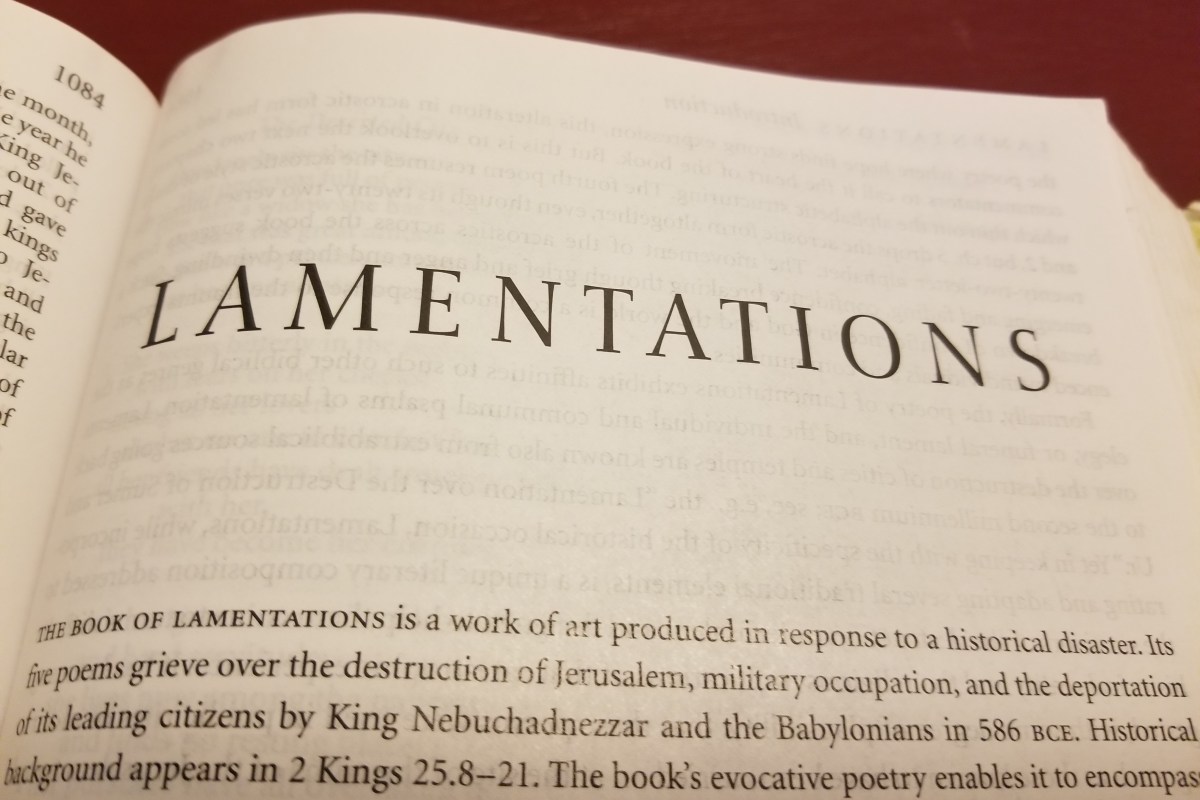
For Lent, our church is going through the book of Lamentations, which consists of five poems all centered around the occupation and exile of Judah by the Babylonians. The temple, which for the people of Judah, is where God resided was destroyed, leaving the people lamenting the destruction of the house of God. Where does God go when there is no home for God? Does God leave a people when there is no dwelling place? Did God leave them before and the Babylonians were their punishment? These are some questions with which Lamentations is beginning to grapple.
Lamentations is a book about grief. It’s a poetic representation of our communal grief. How do we grieve things together? It’s a book that allows us to be angry with God, to blame God, even if God is not at fault. There is room in our grief for anger. There is also room in our faith for this kind of grief and anger. The book is about a group of people who have been destroyed and occupied. It is a book about a group of survivors dealing with trauma.
Our pastor has been bringing out the individual nature of grief. What are we grieving this Lent? What do we need to do in order to properly grieve? This is important. It is important to learn how to grieve and to do it well. It is also important for us to learn how to handle other people grieving, how to give them space to be angry, to cry, to blame God, to question God, regardless of where blame ought to lie. These are all good things for us to learn.
My mind, however, immediately went to thoughts about communal grief, particularly as a white male. I am someone who benefits both from my whiteness and my maleness. How can I, as a white person, identify myself in the story of Lamentations? I do not grieve the destruction of white people. My white ancestors are the ones who destroyed entire nations of Native Americans and have occupied their lands for hundreds of years. My white ancestors are the ones who enslaved Africans and brought them to the Americas. I do not identify with those lamenting in this Scripture. I identify with the descendants of those who did the destroying, occupying, and enslaving.
Therefore, I am left wondering how to grieve the sins of those who came before me. How do I grieve white supremacy? How do I sit with the grief that I benefit in numerous ways because of my whiteness that black and brown skinned people do not? I’m left feeling angry at the injustice. I’m left feeling frustrated with my own complicity in the ransacking of the Temple, in the systematic oppression of black people in the U.S. In the past I have felt defensive and thought things such as: I didn’t enslave anyone. I didn’t kill anyone, incarcerate somebody, or enact racist laws. But, I must contend with the fact that I benefit from white people who did. I am in a place of privilege because white people before me did those things.
While I feel disconnected from white people as a racial identity, I must also acknowledge that I am intricately linked to all the white people who came before me. In lieu of the Old Testament, I must learn what it means to ask for communal forgiveness for what my white European ancestors did to Native Americans and African Americans. I must learn how to claim those as my people and to repent for their sins. I must learn that I don’t get to pick and choose the community I came from, that I don’t get to pretend their sins don’t benefit me now.
While Lamentations doesn’t feel like a book written for me to give lament to my own individual grief, it is a book that is giving me new eyes to see those who are grieving. It is giving me lenses to see those who are lamenting, those who are crying out for justice and for equality and to be seen and heard in a country where their voices have been stifled. Lamentations is giving me the chance to sit down and be quiet while I listen. I pray that this book continue to shape me, to give me eyes to see oppression in new ways. I pray that either this book or another book in Scripture help me find the communal language to ask forgiveness, to repent, and to seek wholeness with those whom my ancestors have destroyed.

 Timothy Burge-Lape